
Tattoo removal rarely follows the same schedule for everyone, even when two tattoos look similar. The number of tattoo removal sessions you may need depends on details such as ink color and density, tattoo age and location, and how your body responds to treatment. Looking at these factors offers a more realistic way to estimate the removal process than relying on tattoo size alone.
How soon will I see fading after tattoo removal?
Fading can continue between appointments as the body gradually processes fragmented tattoo pigment.
How Many Tattoo Removal Sessions Are Usually Needed?
There is no universal session count for laser tattoo removal. Many tattoos require several appointments, and some treatment plans may extend to 10 sessions or more. The number depends on characteristics that cannot be accurately judged from tattoo size alone.
A small tattoo packed with dense, layered ink, for example, may require more treatment than a larger tattoo with lighter shading. The goal also matters. Someone who wants enough fading for a future cover-up may reach that point sooner than someone seeking the greatest possible clearance.
Why Tattoo Removal Is a Gradual Process
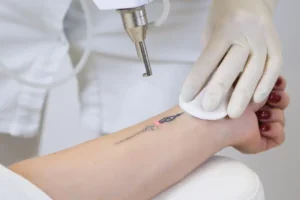
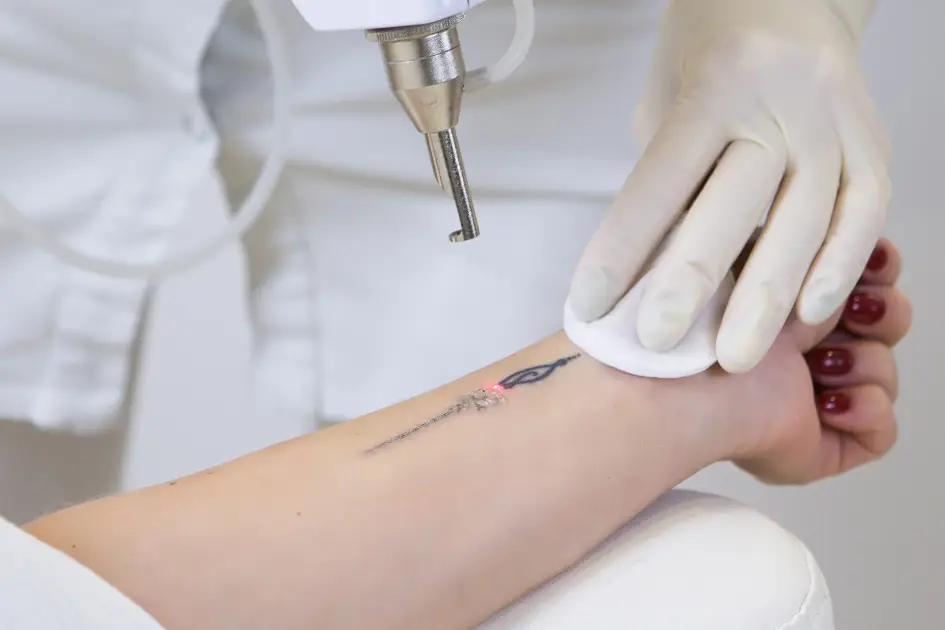
Laser tattoo removal works by directing energy toward tattoo pigment. That energy fragments targeted ink particles, after which the body gradually processes the resulting particles.
This explains an important part of the tattoo removal timeline: the laser appointment is only one stage of the process. Changes continue after you leave the treatment room.
Skin also needs time to recover before another session. Trying to compress several treatments into a short period does not automatically produce faster clearance and may place unnecessary stress on the treated area. Treatment intervals are selected according to factors such as healing, skin response, tattoo characteristics, and the provider’s clinical assessment.
7 Factors Affecting Tattoo Removal Results
The factors affecting tattoo removal are interconnected, which is why predicting an exact session count before treatment can be difficult. These seven considerations can help explain why timelines vary.
1. Ink Color
Black ink often responds differently from colored pigments because laser wavelengths interact with specific colors in different ways. A multicolored tattoo may require a treatment approach that accounts for several pigments rather than using the same settings throughout the entire process.
Some colors can be more resistant to particular wavelengths, making the tattoo’s color palette an important part of treatment planning.
2. Ink Density
The amount of pigment deposited into the skin can have a significant effect on removal. Ink density removal becomes particularly relevant with heavily saturated tattoos, bold lines, repeated touch-ups, and areas containing solid blocks of color.
More pigment gives the treatment process more material to address. A tiny but heavily saturated tattoo should therefore not be assumed to disappear quickly simply because it covers less skin.
3. Professional or Amateur Application
Professional tattoo artists generally place ink with greater consistency and may deposit substantial amounts of pigment at relatively uniform depths. Amateur tattoos can contain less ink, but pigment depth may be inconsistent.
Neither category guarantees an easy or difficult removal. How the tattoo was applied simply gives the provider another clue about what may be beneath the visible design.
4. Tattoo Age
Time naturally changes the appearance of many tattoos. An older tattoo may already show some fading before laser treatment begins, while a newer tattoo may contain more vivid and concentrated pigment.
Age is still only one part of the assessment. An older tattoo that has been repeatedly touched up could contain more pigment than its age initially suggests.
5. Tattoo Location
Placement can affect the rate at which a tattoo responds. After laser energy breaks pigment into smaller particles, the body plays a role in processing them.
Circulation and lymphatic activity vary across different parts of the body, so tattoos on certain areas may not fade at exactly the same rate. This is one reason providers consider location rather than estimating treatment solely from a photograph of the tattoo.
6. Individual Skin and Body Response
People do not heal or respond to treatment identically. Skin characteristics, the body’s response to fragmented pigment, and recovery between appointments can all influence progress.
A provider may adjust treatment parameters or timing after observing how the skin responds. Following the recommended aftercare instructions also gives the treated area appropriate conditions for recovery.
7. Laser Technology
The equipment used matters because different wavelengths and pulse durations interact with tattoo pigments differently. Discussions about picosecond vs Q-switched laser technology often focus on how quickly each system delivers energy and how effectively a particular device can target certain pigments.
Picosecond lasers deliver energy in extremely short pulses, while Q-switched systems use nanosecond-range pulses. The better choice is not determined by the technology’s name alone. Tattoo color, depth, skin characteristics, available wavelengths, and the provider’s treatment approach all need to be considered.
Where the Kirby-Desai Scale Fits Into Tattoo Removal Planning
The Kirby-Desai Scale was developed as a way to estimate the potential difficulty of laser tattoo removal using several patient and tattoo characteristics.
Rather than relying on a single detail, such as tattoo size, the scale considers multiple variables that may influence treatment. These include skin type, tattoo location, ink color, amount of ink, scarring or tissue changes, and layering.
A scoring method can help organize the initial assessment, but it should not be treated as a promise that a tattoo will disappear after an exact number of visits. Real treatment response still provides information that an estimate made before the first session cannot fully capture.
The scale is useful mainly because it reinforces an important point: tattoo removal depends on a combination of characteristics, not one isolated feature.
Does Complete Tattoo Removal Always Happen?
Complete clearance cannot be guaranteed for every tattoo. Some tattoos fade extensively, while others may leave residual pigment, subtle color differences, or visible skin changes.
Pre-existing scarring can also become easier to notice as the ink fades because the tattoo may previously have concealed some of the skin’s texture.
What Can Change Your Tattoo Removal Timeline?
An initial estimate is useful, but the plan should leave room for adjustment. Your tattoo removal timeline can change as the provider sees how different pigments respond, how the skin recovers, and how much fading occurs between appointments.
This is also why comparing your progress with another person’s tattoo removal can be frustrating. Even tattoos with similar dimensions can differ in pigment composition, density, depth, age, placement, and previous tattoo work.
Revenge MD Tattoo Removal in Las Vegas, NV
For people considering tattoo removal in Las Vegas, NV, Revenge MD offers laser tattoo removal for unwanted tattoos and body art. There is no need for an elaborate explanation about why you want a tattoo removed. A former partner’s name, an impulsive decision, an old design, or simply a tattoo that no longer feels relevant are all valid reasons to consider treatment.
Our team utilizes high-intensity laser energy to penetrate the skin and target the pigment that makes up tattoo ink. The pigment is broken into smaller particles so the body can gradually process them.
Not sure how many sessions you’ll need? Call Revenge MD in Las Vegas, NV for a free, personalized consultation today!
Frequently Asked Questions
Can a tattoo be removed in one laser session?
Most tattoos require multiple sessions because pigment is treated progressively and the skin needs adequate recovery time between appointments.
Do older tattoos require fewer sessions?
Older tattoos may sometimes respond more readily because some natural fading has already occurred, but ink density, color, depth, and other characteristics still influence the total treatment time.
Does tattoo size determine the number of sessions?
Tattoo size matters, but pigment density, color, location, application method, skin characteristics, and treatment response can be just as important.